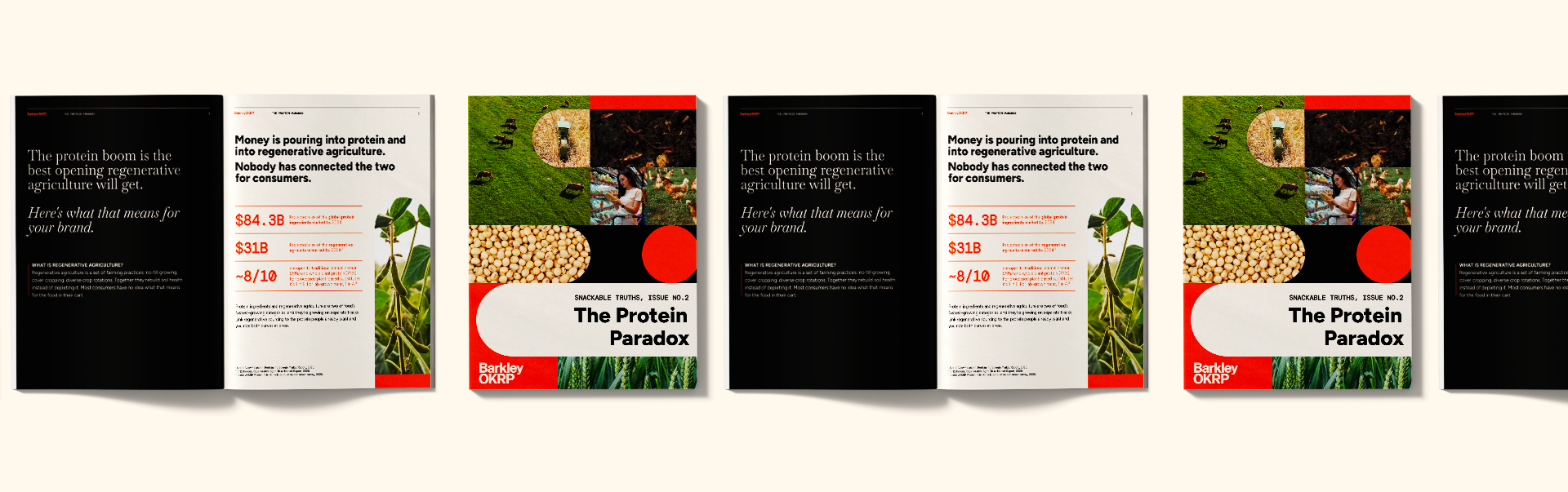
Regenerative is the new “natural,” but protein brands still have time to change course.


"Natural" never got a legal definition. The brands that built on it lost a differentiator, and some had to pull it off the pack entirely. "Regenerative" is heading down the same road, with federal money speeding it up.
Here's what food and protein brands can learn from it, and what they can do together while the window is open.
Key Points
- "Regenerative" is following the arc of "natural": fast adoption, no shared definition, rising skepticism.
- USDA's Regenerative Pilot Program grows from $700 million to $1 billion in fiscal 2027 and is framed around public health. That will put the word in front of far more shoppers than understand it.
- Brands that agree on a definition and fund the proof together can set the standard and earn the trust that comes with it.
The most powerful claim on the shelf still has no official meaning.
In 1993, the U.S. Food and Drug Administration offered an informal take on what "natural" means on a food label: nothing artificial or synthetic added that wouldn't normally be expected in that food. It was only ever guidance, never an official definition or rule; More than thirty years later, it’s still the unofficial standard.
The gap got filled anyway, just not by the industry. Through the 2010s, shoppers and consumer groups sued over "natural" claims again and again, naming J.M. Smucker, Chobani, Kraft, KIND and others.
The FDA asked for public input in 2015, collected more than 7,600 comments and never set a definition. Some brands paid a direct price. General Mills agreed in 2018 to drop "100% Natural" from Nature Valley granola bars, a claim that had been front and center on the box for years. And every brand leaning on the word lost something harder to put a number on: once anyone could say "natural," it stopped setting any one product apart.
And yet "natural" still sells. In BarkleyOKRP's 2026 Protein Pulse Check, 40% of consumers said they trust natural or organic status as a purchase cue. Only 19% named a third-party certification as the signal they trust most. A word with no fixed meaning outperforms the systems built to verify claims. That works right up until shoppers learn what the word doesn't guarantee, and then the brand pays for it in trust.
Regenerative is on the same road, moving faster.
"Regenerative" has moved from niche to mainstream with almost none of the guardrails consumers say they want. Our research for The Protein Paradox found:
- 69% of consumers have never heard of regenerative agriculture or can't define it.
- 52% suspect it's a marketing slogan rather than a verified standard.
- Separately, researchers classified 98% of 1,233 environmental claims made by 33 major meat and dairy companies between 2021 and 2024 as greenwashing (Congreves et al., PLOS (Public Library of Science) Climate).
There's still no federal definition. California's State Board of Food and Agriculture adopted one in January 2025, and the state has been clear it isn't meant for certification or legal statute.
Now Washington is amplifying the term. USDA launched its Regenerative Pilot Program in December 2025 with $700 million, and in September announced it will grow to $1 billion in fiscal 2027. Federal health agencies are also funding research on links between regenerative farming and public health, so expect to hear the term outside the farming world, too.
Millions more shoppers are about to hear the word, many of them in a health context, and there’s still no definition behind it. Sound familiar?
Why protein brands should pay attention first.
Protein is where this lands hardest. As we laid out in The Protein Paradox, the global protein ingredients market is projected to reach $84.3 billion by 2033, and the regenerative agriculture market is growing at an estimated 11.5% a year. Consumers buy protein for themselves: 66% cite personal health as their top reason for eating more of it. Only 2.9% say the environment drives their protein choices.
So the strongest regenerative story for protein is a health story, specifically nutrient density. A 2022 peer-reviewed study in PeerJ found regeneratively farmed crops averaged up to 34% higher levels of key nutrients than crops from paired conventional farms. One study isn't settled science. It's the kind of proof this category needs a lot more of.
That raises the stakes. An environmental claim that overreaches gets you a bad headline. A nutrition claim that overreaches gets personal fast. It's about what people feed their families, and that trust is a lot harder to win back. Brands that want to lead with health need independent, shared evidence behind the claim before it goes on pack.
Four lessons for protein brands from the "natural" era.
1. Shape the definition early.
The food industry spent years waiting for the FDA (Food and Drug Administration) to settle "natural." It never did, and the rules got written without them. USDA (United States Department of Agriculture) funding regenerative practices on the farm still leaves open what a regenerative claim on the package means. That's the opening. Brands that help define it now, alongside farmers and independent experts, can shape a standard they'll build on for years.
2. Build the standard together.
A definition written by one company reads like a marketing claim. Shoppers give a lot more credit to one that competitors, farmers and scientists agreed on together. Other industries have already worked this out. I’ve seen this firsthand in freight, where competing companies have co-invested in decarbonization pilots none of them would fund alone. Pre-competitive work succeeds when a problem is too big and too public for any single company to own. Regenerative claims fit that description. A shared Regenerative Protein Playbook, with plain-English definitions and claim guardrails for meat, dairy and plant protein, gives every participating brand cover that no standalone sustainability page can.
3. Let farmers and dietitians do the talking.
In our research, independent farmers and registered dietitians ranked as the most credible messengers on protein and regenerative claims. Brands ranked last. The tool consumers most want is digital traceability: farm-level sourcing data they can scan at the shelf. Shoppers also name cost (32%), confusing labels (27%) and limited availability (22%) as their main barriers. No single brand can fix shelf-level confusion alone. Brands could get further by backing shared traceability and putting farmers and dietitians out front.
4. Co-fund the proof early.
Nutrient-density research benefits every brand that sources regeneratively, which makes it an obvious candidate for joint funding across farmers, processors, brands and retailers. Collaborations work best with a clear goal and an honest end date, which includes knowing when one has done its job. A research consortium with a defined question and timeline is easier to join and easier to defend to a Chief Financial Officer.
The window is open, for now.
Sustainability-marketed products drove 41% of CPG (Consumer Packaged Goods) growth from 2013 to 2024, according to NYU Stern's Center for Sustainable Business. Meanwhile, trust is getting harder to earn. Edelman's 2026 Trust Barometer special report on brands found that two-thirds of consumers are hesitant or unwilling to trust people with different values or information sources, and for that group, unpaid voices are five times more powerful than paid brand voices in building trust. Regenerative can ride the first trend only if it survives the second.
"Natural" shows what happens when an industry lets a valuable word drift: it still sells, but it no longer sets anyone apart. Regenerative can go a different way. Protein brands that come together now to define the term and fund the proof behind it will set the rules the rest of the category follows, and they’ll be the ones shoppers believe. It starts with getting the right people in the same room.

Snackable Truths, Issue No. 2: The Protein Paradox.
__
Want a seat at the table? Join BarkleyOKRP's Food & Ag Collaboration. Contact our Chief Marketing & Growth Officer, Brandon Cooke, at brandon@barkleyokrp.com to start the conversation.